Both surfaces offer unique advantages but when it comes to Eugene’s year-round rain, diverse sports community and ambitious goals for economic impact, synthetic turf is what the community needs for success.
Golden Gardens: A Game-Changing Opportunity
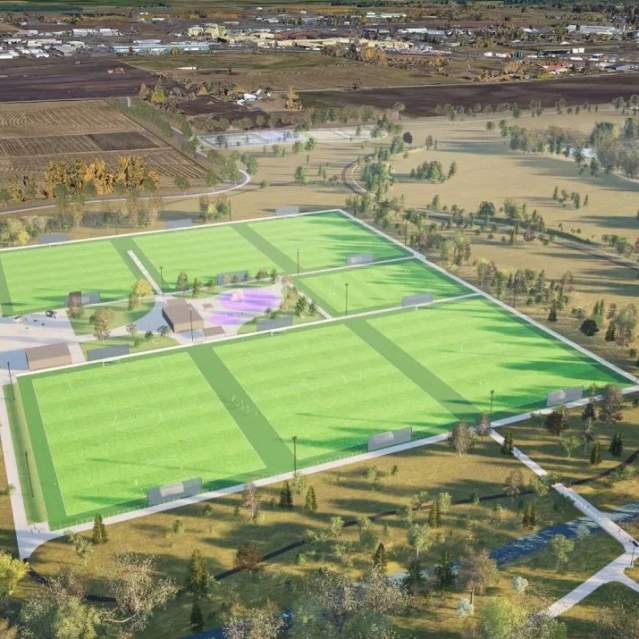
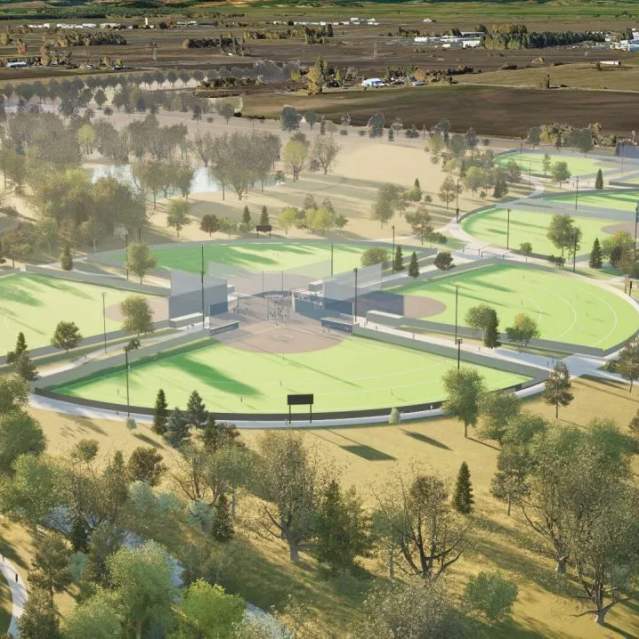
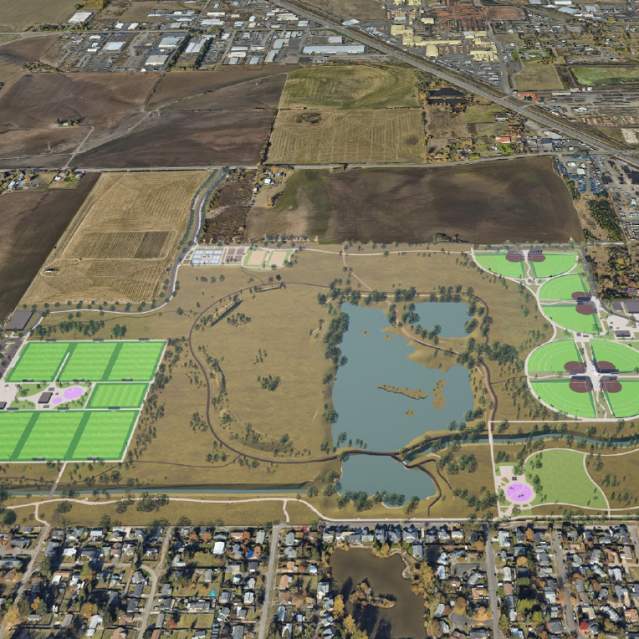
The Golden Gardens development is set to transform a 223-acre public park in northwest Eugene into a dynamic athletic hub with the perfect balance of 44 acres of sports complex, 168 acres of natural area and 11 acres of neighborhood park. The sports complex will feature 14 sports fields, including three full-size baseball fields, five softball/baseball fields, six soccer/football fields and a habitat conservation area with trails and a neighborhood park. The complex is designed to support regional tournaments that drive economic impact, youth leagues and adult recreation.
But to meet this ambitious goal, the community needs an infrastructure that supports heavy and continuous use, minimal downtime and maximum versatility. That’s where synthetic turf comes into play.
People First: Safety, Accessibility and Playability
Recent research is helping change the narrative around synthetic turf. While older studies raised valid injury concerns, a 2024 study from UT Southwestern Medical Center found that football players on natural grass experienced more severe concussions than those on synthetic turf. The turf’s consistency and improved underlayment systems can reduce injury risk in high-impact sports.
Accessibility is another huge win. Synthetic fields offer a smoother and flatter surface, better supporting athletes with disabilities including those using wheelchairs or prosthetics. These inclusive features are essential for a community park meant to serve everyone.
Yes, synthetic turf requires petroleum-based materials and can get hotter than grass—but the tradeoffs are important to consider. Eugene gets over 45 inches of rain annually, and natural grass fields can become unusable or unsafe after a heavy rainstorm or saturation from consecutive days of rain.
In contrast, synthetic turf drains rapidly, allowing play almost immediately after rain. It requires no watering, which conserves one of Oregon’s most valuable resources. And synthetic turf also eliminates the need for pesticides and fertilizers, reducing runoff into nearby wetlands and ponds.
While natural grass has environmental benefits like CO₂ absorption and cooling effects, its significant water and chemical use make it less practical for a large-scale high-use complex like Golden Gardens.
Boosting Winter Economy
Sports play an extremely important role in the local economy, and events bring tens of millions of dollars in economic impact to the region from spring through fall, but businesses need more demand in the winter. The seasonality of visitors is hard on hotels and restaurants and requires them to lay off staff in winter when there are fewer visitors.
Eugene averages 28.6 inches of rain from November to March. Unfortunately, outfitting the sports complex with natural grass fields and diamonds would force the community to pause play for five months out of the year—the time of year that driving visitor demand is needed most.
Synthetic turf comes with a high upfront cost, but the return on investment is undeniable. Take Medford’s Lithia & Driveway Fields—the largest municipal FieldTurf installation in the U.S. with nearly 1.5 million square feet of turf. The sports complex has hosted over 70,000 games and generated $173 million in economic impact since opening in 2008—over five times what it cost to build. In 2024, the park brought in 240,000 visitors and generated $13.4 million in estimated economic impact.
Because synthetic fields can be used year-round with minimal recovery time between games, Lithia & Driveway Fields has seen measurable amounts of success since the complex opened. Unlike grass, which needs downtime to heal, synthetic turf is always ready for play.
Beyond Medford’s success, lifecycle studies show the long-term financial advantages of synthetic turf. In a recent OCMI analysis for a school athletic complex, synthetic turf had a 150% higher upfront cost than grass, but maintenance costs for grass were 250% higher over 20 years. Synthetic fields also supported more rental hours per week at higher rates, leading to a break-even point in just eight years. Grass, by comparison, couldn’t generate enough revenue to cover its upkeep. For Golden Gardens, the same principle applies—synthetic turf maximizes both use and return on investment.
Golden Gardens has the same potential. With 14 high-quality synthetic fields, Eugene could become a major destination for tournaments in soccer, football, lacrosse, ultimate frisbee, softball and baseball—bringing in millions in tourism dollars each year.
Community members often use turf fields for much more than just organized sports, especially because of their durability, weather resistance, and all-season accessibility.
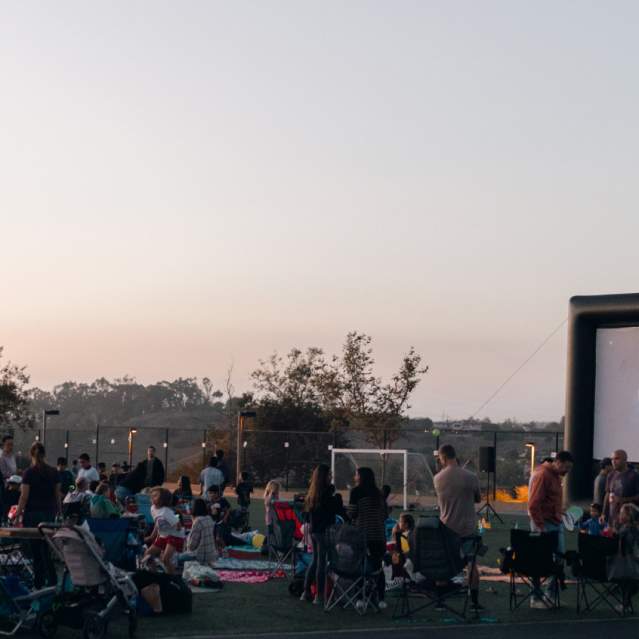
Families often use already existing turf fields in the community as a place for their children to just run around and play since grass fields are often muddy, haven't been mowed or are closed for grass reparation. In other communities, turf fields are often used for neighborhood block parties, outdoor movie nights, group fitness classes, summer camps and after-school programs.
Turf fields become true community gathering spaces, supporting a wide range of recreational, cultural and practical uses that grass fields often can’t accommodate consistently. Their versatility adds real value to the social and civic life of a community.
Synthetic turf isn’t perfect—it has environmental and heat-related drawbacks—but it’s the best option for Golden Gardens based on Eugene’s climate, community needs and economic goals.
By investing in synthetic turf, the City of Eugene can build a resilient, inclusive and high-performing sports complex that serves athletes of all ages and abilities and fuels the region’s growing reputation as a premier sports destination. In addition, by locating the complex in the Bethel neighborhood, it will help eliminate a major barrier to sports participation and provide access to quality playing fields for underserved youth.
Let’s make the smart play. Let’s build Golden Gardens for the future—with synthetic turf.
Author
Kate Walkup
Kate is the Sports Sales and Marketing Coordinator for the Eugene, Cascades & Coast Sports Commission. Kate graduated, Summa Cum Laude, with a B.A. in Journalism and Media Studies from Linfield University in McMinville, Oregon. While at Linfield she competed as a swimmer and was recognized with multiple awards.